


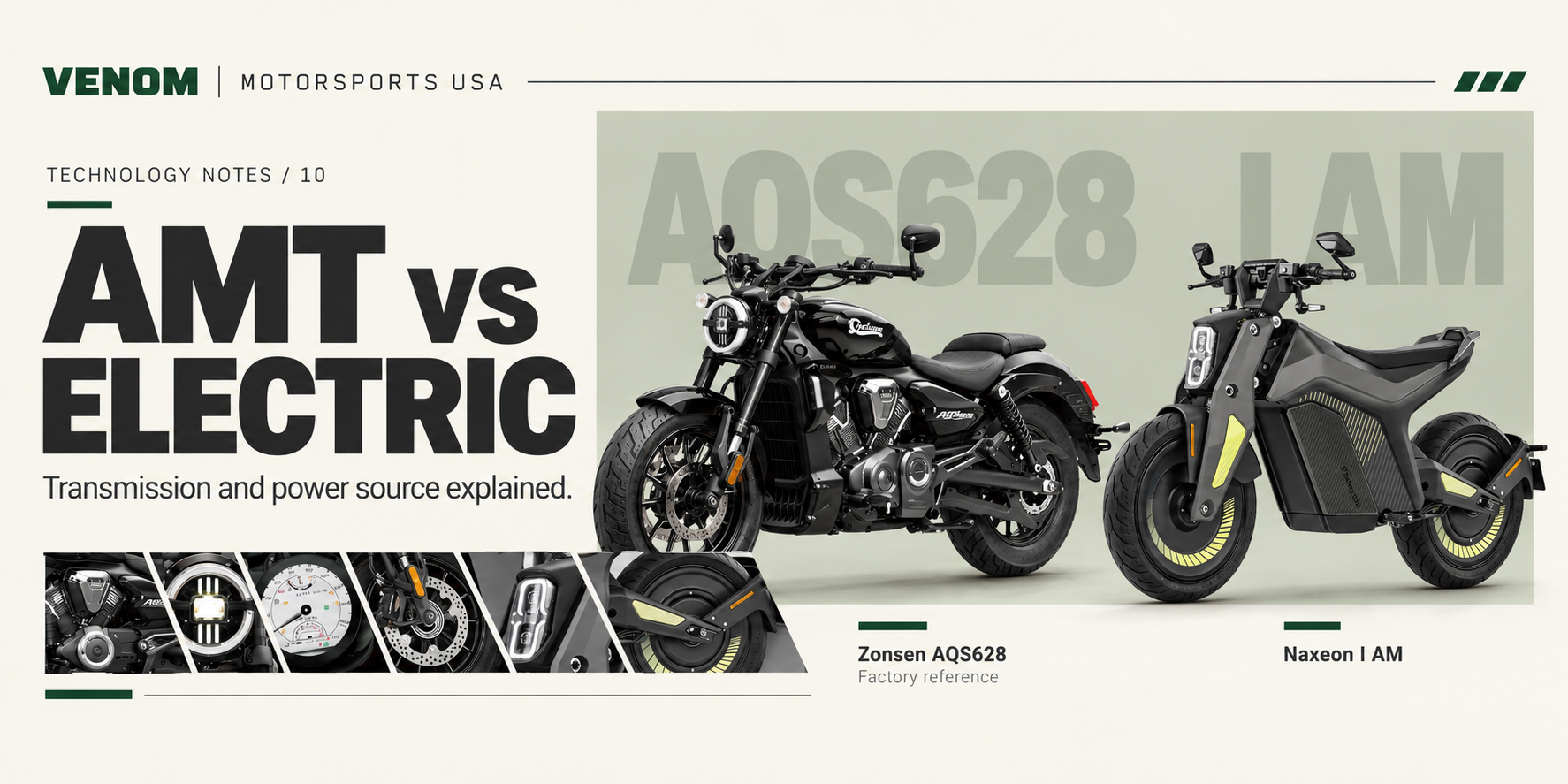
AMT vs Electric Motorcycles: Transmission or Power Source?
AMT and electric describe different parts of a motorcycle. AMT describes how a geared transmission is operated; electric describes the source of propulsion. A gasoline motorcycle can use electronic transmission controls and still be a gasoline motorcycle.
This distinction helps when a search for automatic motorcycles brings together AMT models, scooters and battery powered motorcycles. Similar convenience at the controls does not establish that they share the same engine, motor or transmission.
Ask the power question and the transmission question separately
| Question | What the answer tells you | What it does not establish |
|---|---|---|
| What propels it? | A combustion engine, an electric motor or another specified powertrain | Who chooses gears |
| How is transmission operation controlled? | What the rider operates and what the system automates | Whether the motorcycle uses gasoline or a traction battery |
| What supplies its energy? | The fuel or charging arrangement to plan around | The complete set of riding controls |
Use both questions on the same listing. A complete specification should let you describe the motorcycle’s power source and its gear operation without relying on a broad word such as automatic.
Electronic control is not electric propulsion
An AMT can use electrical actuators to operate mechanical transmission functions. Yamaha’s Y AMT technology explanation describes automatic and rider requested shifting modes. The control technology changes the rider’s shifting tasks; it does not make AMT a battery propulsion category.
The same distinction applies to electric start. A combustion engine started by an electric starter remains a combustion engine. Read the engine or motor specification and the fuel or traction battery information to identify the actual power source.
The Zonsen AQS examples are combustion engine platforms
The supplier catalogue supplied to Venom lists the AQS250 with a 250cc, liquid cooled, four stroke twin cylinder engine and identifies separate MT and AMT variants. The AQS628 table lists a 578cc engine and also distinguishes MT and AMT versions. The model name AQS628 should not be substituted for its listed displacement.
Those factory specifications illustrate gasoline engine platforms with a transmission choice. They are not specifications for battery electric motorcycles. They also are not a final USA sales offer: equipment, availability, pricing and documentation must be confirmed for the version Venom supplies.
For the supplier details and the limits of the currently verified information, read our Zonsen AMT motorcycle preview. The AQS401 remains outside this technical example because its specification has not been verified.
What an electric motorcycle listing tells you instead
Venom’s E Vader listing identifies a 2000W brushless electric motor and a 72V lead acid battery. The Naxeon I AM listing identifies a 6.5kW motor and a 72V battery platform. These are propulsion specifications.
Do not infer an AMT from an electric motor, or interpret speed governor settings as mechanical gears. Check the particular motorcycle’s transmission and control description separately. Likewise, an electric motorcycle can have reduction gearing without using the AMT arrangement discussed here.
Honda’s WN7 technical announcement, for example, describes an electric motor transmitting power through a gearbox to a belt drive. It is a useful reminder that the words gearbox and electric can coexist. That example does not define the hardware fitted to Venom’s electric models.
Turn a vague preference into a clear request
If you say that you want an automatic motorcycle, explain the result you want. You might want the motorcycle to select gears, want less clutch lever work, want battery propulsion, or want several of those features together.
Those are different requests. Someone interested in battery charging at home is asking about an energy source. Someone interested in automatic gear changes on a gasoline motorcycle is asking about transmission operation. Keeping them separate prevents a recommendation that solves the wrong problem.
Once the terms are clear, compare actual motorcycles. Our E Vader versus Naxeon I AM comparison addresses two electric platforms. Our AMT versus quickshifter comparison addresses two approaches to shifting. Neither comparison replaces the other’s buying question.
Common AMT and electric questions
Are AMT motorcycles electric?
The AMT label does not establish that. The Zonsen examples discussed here use combustion engines. Identify propulsion from the actual engine or motor specification.
Does every electric motorcycle use AMT?
No. Electric propulsion does not specify an automated manual transmission. Read the individual design and control information.
Does an electric shift actuator need a charging routine like an electric motorcycle?
Do not confuse a control actuator with a traction battery. Follow the complete motorcycle’s manual for its electrical system and energy requirements.
Browse Venom’s automatic motorcycles for models with automatic operation and the electric vehicle collection for battery powered options. On each model, confirm both what propels it and how its controls operate.