


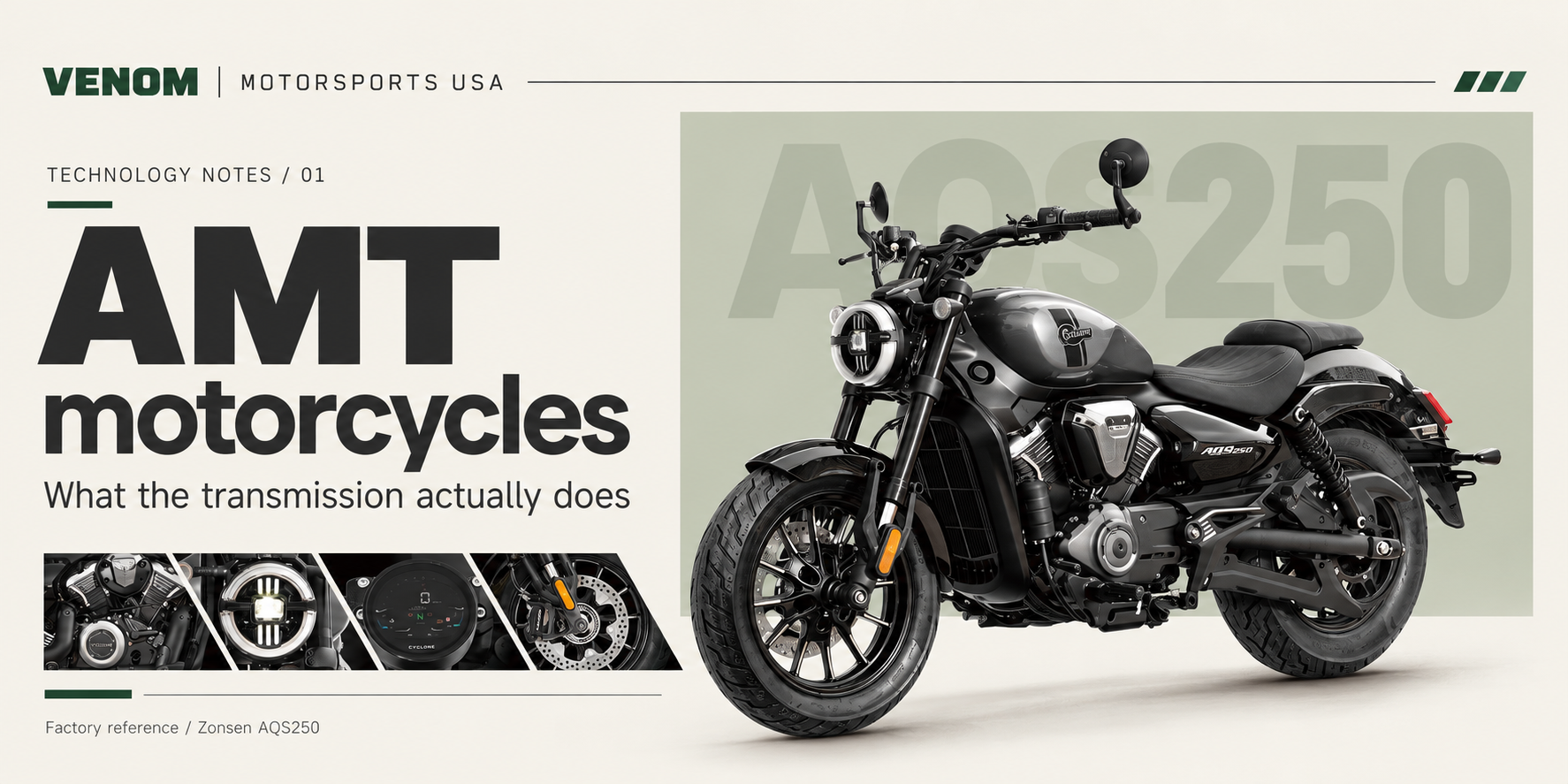
What Is an AMT Motorcycle? How the Transmission Works
An AMT motorcycle uses an automated manual transmission: a geared transmission in which a control system performs operations that a rider would otherwise manage through the clutch and gear controls. Modern motorcycle AMT systems can offer automatic shifting as well as a mode where the rider requests gear changes. The available controls and modes depend on the motorcycle.
That distinction matters when shopping. An AMT motorcycle is not simply a scooter transmission installed in a different body. It can retain separate gear ratios while changing how the rider operates them. The useful question is what the system actually automates.
What does AMT stand for?
AMT stands for automated manual transmission. The word manual describes the transmission architecture, while automated describes how its operation is controlled. It does not mean the rider must always work a clutch lever.
Yamaha calls its implementation Yamaha Y AMT. KTM also uses the AMT name. These examples show that the term describes a technology category, rather than a single universal set of switches or software features. A feature advertised by one manufacturer should not be assumed to exist on another manufacturer’s motorcycle.
How does an AMT motorcycle work?
A conventional manual motorcycle makes the rider coordinate the clutch, gear selection and throttle. In an automated system, electronic controls coordinate the relevant mechanical operations. In Yamaha’s implementation, actuators operate the clutch and shifting mechanism in cooperation with engine controls. Yamaha describes this in its technical development announcement.
The result can feel familiar in one important respect: the motorcycle still moves through distinct gears. Automation changes the control process; it does not remove the need for a transmission or turn every geared motorcycle into a continuously variable machine.
For a buyer, it helps to separate three questions. Who operates the clutch? Who requests the next gear? And which requests will the control system accept in the selected mode? The owner’s manual should answer all three.
Automatic mode and manual mode are different jobs
Where automatic mode is provided, the motorcycle chooses shift timing according to its programmed logic and inputs. Where a rider selected mode is provided, the rider requests an upshift or downshift through the controls fitted to that model.
Manual mode on an AMT therefore does not necessarily mean manual clutch operation. It may mean choosing gears while the system performs the shift. KTM’s AMT technology guide, for example, distinguishes an automated mode from a rider selected mode. That is a useful example, not a promise about every AMT motorcycle.
Before ordering, ask for a demonstration of the actual controls. A clear explanation should identify the selected mode, displayed gear, method of requesting a shift and any operating restrictions. A photograph of a motorcycle without a clutch lever cannot answer those questions by itself.
What still stays with the rider?
The rider still controls the motorcycle’s direction and speed and remains responsible for judging traffic, road conditions and available traction. Automation of the transmission does not provide steering, balance or a substitute for riding instruction.
It also does not make engine performance irrelevant. Weight, throttle response, riding position and power delivery still affect whether a motorcycle fits its rider. An AMT label should never be used as the only reason to choose a larger or heavier bike.
A useful way to evaluate a motorcycle is to describe your normal journey first. Include parking, junctions, longer roads and any need to move the bike by hand. Then compare the complete motorcycle against that journey, rather than deciding from the transmission name alone.
AMT is one way to offer automatic operation
Automatic motorcycle is a broader shopping term. Different motorcycles can reduce shifting workload through different transmission designs. AMT, dual clutch transmission and continuously variable transmission are not interchangeable descriptions.
The same caution applies to the phrase clutchless. It may describe a riding control arrangement rather than the absence of an internal clutch. Ask what the rider operates and what hardware the motorcycle actually uses.
When browsing Venom’s automatic motorcycle collection, read the transmission specification for each individual model. The collection includes automatic choices; membership in that collection does not establish that a motorcycle uses AMT.
What should you check before buying an AMT motorcycle?
- The exact version. Confirm that the order identifies the AMT variant if the same model is also offered with a manual transmission.
- The controls and modes. Request the operating manual and a clear explanation of how the fitted system works.
- The complete motorcycle. Compare seat reach, weight and intended use alongside the transmission.
- The ownership requirements. Ask for the maintenance schedule, diagnostic support and applicable warranty terms.
- The actual offer. Verify the final equipment, price and delivery information for the motorcycle being sold.
These checks are especially useful for an incoming model. A manufacturer catalogue can explain a platform, but the final sales listing should identify the specification being supplied to the customer.
Common questions about AMT motorcycles
Does an AMT motorcycle still have gears?
Yes. The modern AMT systems discussed here use distinct gears. Automated operation changes how those gears are selected and engaged.
Can you choose gears yourself?
Some systems provide a rider selected mode. Check the specific model’s manual and controls instead of assuming all AMT motorcycles offer the same arrangement.
Is AMT only for beginners?
No. A rider may prefer automated operation for everyday convenience or simply prefer its controls. Suitability still depends on the complete motorcycle and the rider’s experience.
Is an AMT motorcycle maintenance free?
No transmission label establishes that. Use the maintenance schedule for the exact motorcycle, including its engine, transmission, final drive and other service items.
Choose an AMT motorcycle by what it does, how it fits and how it is supported. Start with the verified model specification, then use Venom’s Motorcycle Finder to compare the wider features that matter to your ride.
If you are also seeing battery powered models in your search, our AMT versus electric motorcycle explanation separates the transmission question from the power source. Electronic shift control alone does not make a motorcycle electric.